
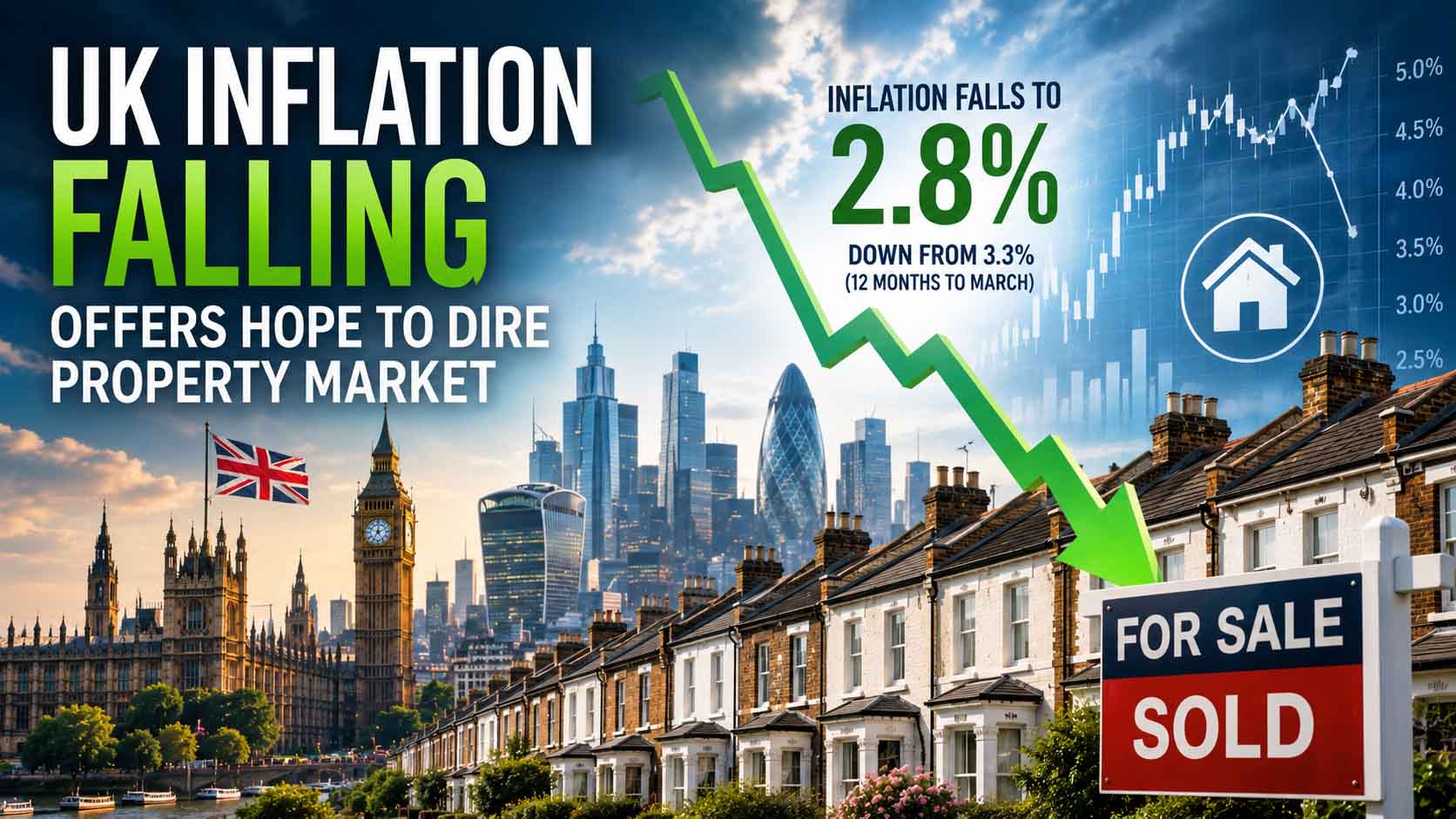
UK Inflation falling offers hope to dire property market
UK Inflation Falls to 2.8%: What the Surprise Drop Means for Property, Mortgages and the Economy
The UK property and mortgage sectors have reacted positively after the latest inflation figures unexpectedly showed a sharper-than-anticipated decline, raising hopes that borrowing costs could ease in the months ahead.
According to newly released government data, the headline rate of inflation dropped to 2.8%, surprising many economists who had expected inflationary pressures to remain stubbornly high. Although inflation still remains above the Bank of England target of 2%, the latest figure marks a significant improvement compared with the 3.3% recorded over the 12 months to March.
The development has sparked cautious optimism across the housing market, where affordability pressures, elevated mortgage rates, and economic uncertainty have weighed heavily on buyer confidence throughout the past year.
Why the Inflation Drop Matters
Inflation is one of the most closely watched indicators in the UK economy because it directly influences interest rate decisions by the Bank of England. When inflation remains high, policymakers are typically reluctant to reduce interest rates, fearing that lower borrowing costs could reignite price growth.
For homeowners, first-time buyers, landlords, and businesses, this matters enormously because mortgage pricing is closely linked to expectations surrounding future base rates.
The unexpected fall to 2.8% has therefore been interpreted by many in the property sector as a potentially important turning point.
While inflation remains above the official target, the latest figures suggest that some of the intense price pressures experienced during recent years may finally be beginning to ease.
Mortgage Industry Welcomes the News
Among the first to respond was Ben Thompson of Mortgage Advice Bureau, who described the inflation drop as exactly the kind of signal borrowers had been waiting for.
Thompson said the easing inflation environment could help mortgage rates gradually move lower, potentially improving affordability and helping to restore confidence among hesitant buyers.
His comments reflect a broader mood within the housing industry, where many prospective purchasers have delayed decisions amid uncertainty surrounding interest rates, household bills, and the wider economy.
Research cited by Thompson suggests that 41% of prospective buyers are currently waiting for a clear economic signal before making their next move. That statistic highlights how sensitive housing demand has become to economic conditions and monetary policy expectations.
For many households, the combination of higher mortgage repayments, rising living costs, and concerns over job security has made property decisions increasingly difficult. Even modest improvements in inflation figures can therefore have a meaningful psychological impact on market sentiment.
Fixed Mortgage Rates Showing Signs of Improvement
David Hollingworth from L&C Mortgages also welcomed the lower inflation reading, particularly because many analysts had expected inflation to remain unchanged following recent increases.
Hollingworth noted that lower utility costs had contributed significantly to the latest decline, offering some relief to consumers already struggling with elevated household expenses.
However, he also warned that global geopolitical instability continues to cloud the outlook.
Ongoing tensions involving Iran and wider concerns in global energy markets have contributed to fears that inflationary pressures could persist for longer than hoped. These international uncertainties remain a major concern for financial markets because sustained energy price increases often feed directly into consumer inflation.
According to Hollingworth, these worries have already influenced mortgage pricing.
Earlier in the year, many analysts expected the Bank of England to implement several base rate cuts during 2026. However, persistent inflation concerns and global instability caused lenders to reprice fixed mortgage products upward.
Even so, there are now signs that the worst of that spike may have passed.
L&C’s remortgage tracker indicates that the average of the top ten lenders’ best two-year remortgage fixed rates has fallen back to 4.78%, its lowest level since the end of March and notably below the recent peak where average rates exceeded 5%.
This reduction, while modest, could prove highly significant for borrowers approaching the end of fixed-rate deals. Thousands of homeowners continue to face the prospect of refinancing from historically low pandemic-era rates onto far more expensive products.
Any sustained downward movement in mortgage pricing would therefore provide welcome financial relief.
Property Sector Remains Cautious
Despite the positive reaction, industry figures continue to stress that the economic outlook remains uncertain.
Nathan Emerson of Propertymark described the latest inflation figure as encouraging but warned that the UK remains some distance from achieving the central bank’s 2% target.
Emerson emphasised that global instability continues to create significant anxiety for households already managing stretched budgets and rising costs.
Energy prices remain a particular concern. Although some recent reductions have helped ease inflation, future increases linked to geopolitical events could quickly reverse recent progress.
Consumers are also facing uncertainty over future mortgage costs, especially as lenders continue adjusting pricing in response to changing market expectations.
For many families, affordability pressures remain intense even if inflation is now easing.
Wages have risen in several sectors, but in many cases they have struggled to fully keep pace with the cumulative increase in living costs experienced over recent years. As a result, many households continue to feel financially squeezed despite improving headline economic indicators.
Political Response from Rachel Reeves
The latest inflation figures also prompted a swift response from Rachel Reeves, who argued that the decline demonstrates that the government’s economic strategy is working.
Reeves stated that “we have the right economic plan” and warned that changing direction now could jeopardise economic stability and leave working people worse off.
Her comments come at a politically significant moment, with economic competence and living standards expected to dominate political debate in the months ahead.
The Chancellor also referenced the ongoing conflict involving Iran, acknowledging that while it is “not our war”, it remains an international crisis that Britain must respond to economically and strategically.
Reeves further defended the decisions taken in last year’s Budget, claiming that those measures had helped keep inflation under control despite increasing global instability.
What Happens Next?
The key question now is whether this latest inflation reading represents the beginning of a sustained downward trend or merely a temporary improvement.
Financial markets, mortgage lenders, investors, and consumers will all now look closely at future inflation data for confirmation that price pressures are genuinely easing.
If inflation continues to fall towards the Bank of England target, policymakers may feel more comfortable reducing interest rates later in the year. Such a move could stimulate the housing market by improving affordability and increasing consumer confidence.
However, risks remain substantial.
Global conflicts, volatile energy prices, supply chain disruptions, and broader economic uncertainty all continue to threaten the fragile progress achieved so far.
The property market itself also faces ongoing structural challenges, including limited housing supply, affordability constraints for first-time buyers, and stricter lending conditions.
Even if mortgage rates decline modestly, many buyers may still struggle to secure affordable finance compared with the ultra-low borrowing costs seen during the previous decade.
A Delicate Turning Point for the Housing Market
Nevertheless, today’s inflation surprise has provided the property sector with something it has lacked for much of the past two years: cautious optimism.
The decline to 2.8% may not immediately transform the mortgage landscape, but it does offer evidence that inflationary pressures could finally be moderating.
For buyers waiting on the sidelines, lenders adjusting pricing, and homeowners preparing to refinance, the latest figures represent a potentially important shift in direction.
Whether this proves to be the beginning of a broader economic recovery or simply a temporary pause in inflationary pressures will become clearer in the months ahead.
For now, however, the UK property industry appears relieved to have received at least one piece of encouraging economic news.