
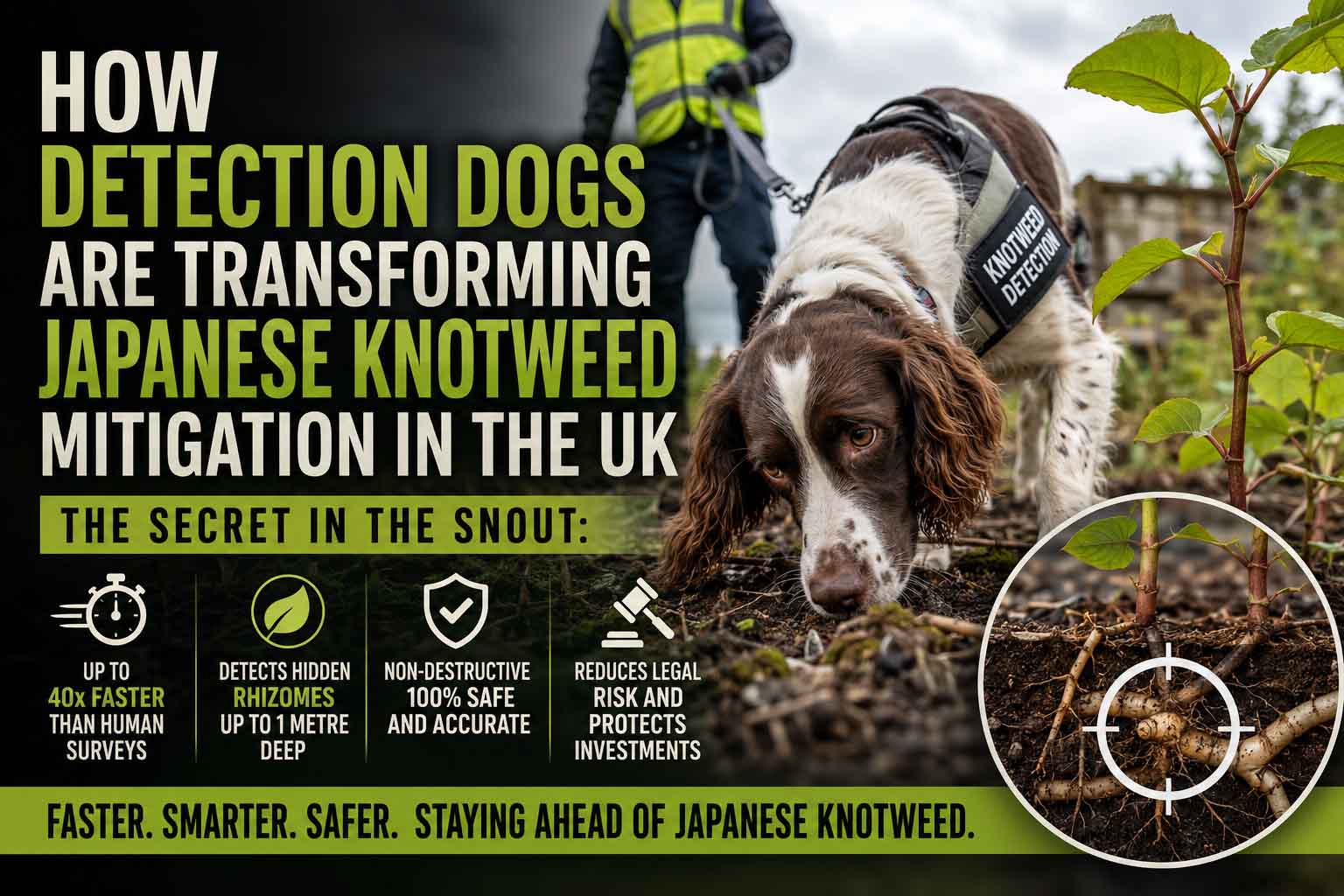
How Detection Dogs are Transforming Japanese Knotweed Mitigation in the UK
The Secret in the Snout
The management of Reynoutria japonica—commonly known as Japanese knotweed—has long been one of the most expensive and legally fraught challenges in UK property development, civil engineering, and residential conveyancing. Introduced to Britain in the 1840s, this aggressively invasive non-native plant is notorious for exploiting structural weaknesses, breaching masonry, disrupting drainage systems, and decimating property values.
For decades, the industry standard for identifying knotweed has relied on visual surveys conducted by human specialists. However, human eyes are limited by seasonal lifecycles, surface vegetation, and deliberate concealment by landowners. Enter a highly innovative, bio-security solution: canine scent detection.
By utilizing bio-detection dogs trained to identify the unique volatile organic compounds (VOCs) emitted by the plant, property professionals and environmental consultants are gaining an unprecedented advantage.
The Science of Scent: Overcoming the Human Limitation
While a human surveyor must look for distinctive heart-shaped leaves, zigzag stems, or hollow, bamboo-like canes, a detection dog relies on up to 300 million olfactory receptors—compared to a human’s mere six million. This acute sensory capability allows dogs to locate infestations by scent alone, moving away from visual confirmation to direct bio-chemical targeting.
The true value of canine detection lies below ground. Japanese knotweed spreads via an extensive underground root network known as rhizomes. These rhizomes can lie dormant for up to 20 years, remaining completely invisible above the surface. Specialist canines can detect minuscule fragments of living or dead rhizome material buried up to one metre beneath topsoil, concrete, or winter mud.
In independent field trials conducted at the ai:LAB research facility—a joint venture between Advanced Invasives Ltd and Swansea University—trained detection dogs successfully identified all major UK-regulated invasive knotweeds (including Japanese, Giant, and Bohemian variants). The mean detection time across all underground testing areas was less than 60 seconds per target.
Operational Benefits for Commercial and Residential Sectors
The integration of canine units into environmental management strategies offers major commercial advantages over traditional methods:
+-----------------------------------------------------------------+

|                    HUMAN SURVEY VS. CANINE SWEEP                |
+----------------------------+------------------------------------+

| Traditional Human Survey   | Canine Scent Survey                |
+----------------------------+------------------------------------+

| - Relies on visible growth | - Identifies hidden rhizomes       |
| - Limited to spring/summer | - Operates effectively year-round  |
| - High risk of human error | - Up to 40x faster site coverage   |
| - Invasive test pitting    | - 100% non-destructive methodology |
+----------------------------+------------------------------------+
- Unrivalled Speed and Cost-Efficiency: According to data published by the Royal Institution of Chartered Surveyors (RICS), canine scent sweeps can cover land up to 40 times faster than manual human teams. An expanse that would take a five-person human crew an eight-hour working day to survey thoroughly can be completed with higher precision by a single handler and dog team in under an hour.
- Mitigating Risk in Property Transactions: In residential conveyancing, sellers frequently tick “not known” on the standard TA6 Property Information Form regarding knotweed presence. Buyers use canine surveys as a definitive pre-purchase screening tool. Specialist firms can even provide multi-year insurance-backed guarantees if a certified canine clears the boundary.
- Preventing Criminal Liabilities on Construction Sites: Under the Wildlife and Countryside Act 1981, it is a strict criminal offence to cause Japanese knotweed to spread in the wild. Civil engineering firms use dogs to scan sites prior to mass excavation. This ensures that potentially contaminated topsoil is flagged before it is moved, preventing catastrophic ecological and legal fallout.
Operational Constraints and Professional Best Practice
While the capabilities of conservation dogs are profound, industry bodies emphasize that they are a tool within an integrated diagnostic strategy, rather than a standalone silver bullet.
- Indication vs. Quantification: A dog is trained to offer a passive alert—usually a “freeze” or “sit-and-stare” behavior—exactly where the strongest scent plume originates. However, the dog cannot assess the overall volume of the biomass, the structural risk to adjacent buildings, or map out legal boundary encroachments.
- Environmental Variables: Scent dynamics are highly dependent on the elements. Heavy crosswinds can displace scent plumes several metres away from the actual root system, while totally impermeable surfaces like thick, freshly laid asphalt can seal odours beneath the surface.
- Welfare Regulations: Dog handling must adhere to strict welfare standards. Guidelines set by the Department for Environment, Food & Rural Affairs (DEFRA) require dogs to work in short shifts—typically 30 minutes at a time—before rotating or resting, ensuring their olfactory receptors remain sharp and false positives are prevented.
The Integrated Future of Weed Diagnostics
To achieve a legally defensible strategy capable of satisfying mortgage lenders or local planning authorities, a multi-tiered approach is required. Forward-thinking land managers are pairing canine surveys with advanced diagnostic technologies. Canines are deployed to rapidly locate hidden rhizomes, logging coordinates via GPS tracking harnesses. Once flagged, qualified invasive-weed specialists use targeted manual validation or molecular tools like quantitative PCR (qPCR) to formulate full, insurance-approved remediation frameworks.
By coupling the ancient, unmatched biology of the canine snout with modern structural expertise, the UK property sector finally has a proactive, year-round weapon to defeat one of its most persistent ecological enemies.